The post Whitening Traumatized Teeth appeared first on Pender Dental Care.
]]>Tooth Pulp Determines Procedure
There are two procedures available to whiten traumatized teeth, each specialized to the unique trauma your teeth have suffered. The first step is to evaluate the traumatized teeth to see if the pulp inside the teeth still lives. X-rays or other tests can determine this. If the pulp is alive, your dentist can perform a normal external bleaching of your teeth.
At times, discoloration may indicate an underlying problem in the teeth, such as irreversible damage or death to the pulp. Before any whitening treatments can occur, the pulp will need to be removed through a root canal procedure. Once you have healed, your dentist can perform internal bleaching of your teeth.
Internal Bleaching
Your dentist will begin by first making a small hole in the back of your tooth, to gain access to the pulp chamber. Extra debris will be rinsed away before your dentist adds a special cement that will prevent the whitening agent from reaching the roots. The whitening agent is then put into the space and sealed shut. You will need to come back to your dentist a few more times to repeat this procedure until you gain the tooth shade desired. Once the tooth has been whitened to your satisfaction, a dental restoration, such as a tooth-colored filling, is placed over the hole originally created in the tooth.
If you are unsatisfied with the discoloration of your teeth due to a trauma, talk to your dentist about your options. External bleaching may be enough to whiten your teeth, but if not, internal bleaching may be your best option to gain the bright, white smile you desire.
The post Whitening Traumatized Teeth appeared first on Pender Dental Care.
]]>The post Tooth Sensitivity appeared first on Pender Dental Care.
]]>Tooth anatomy helps explain why teeth can become sensitive:
- Enamel covers the crown, the visible part of the tooth above the gum line. Enamel is composed primarily of minerals and is the hardest substance in the body. Intact enamel protects the vulnerable tissues inside the tooth.
- Cementum covers the roots of the tooth and, while quite strong, is more porous and softer than enamel.
- Dentin lies just beneath the outer enamel and cementum. It’s a softer tissue filled with microscopic tubules that are connected to the pulp. When damaged enamel or cementum expose part of the dentin layer, the tooth becomes sensitive to things like temperature, sugars and acids, and touch.
- Inside the tooth and protected by the dentin layer are the pulp chamber and root canals. These are filled with pulp, living tissue composed of nerves, blood vessels, and connective tissue. If the pulp is damaged, the blood vessels inside become inflamed, putting pressure on the nerves and causing pain. Infection can set in, destroying pulp tissue and spreading to the surrounding gums and bone.
What causes sensitivity?
Sensitivity is a symptom that the tooth is compromised. You should see your dentist promptly to discover the source of and treatment for your discomfort.
- Tooth Decay
When a cavity is deep enough to penetrate the enamel and reach the dentin, sharp pain when eating certain foods, drinking hot or cold beverages, breathing through the mouth, or brushing can result. Sensitivity can also be a sign that a loose or broken filling needs replacement. Treating a cavity in its early stages or replacing a damaged filling right away prevents decay from reaching the inner pulp and endangering the tooth.
- Infection
Once decay has reached the pulp, the tooth is vulnerable to infection. This infection can spread to bone and gum tissue. Because the inner pulp contains nerves, infected and inflamed pulp can be very painful. Root canal treatment is often necessary to save the tooth.
- Trauma
A chip, crack, or fracture can damage tooth structure and expose dentin and pulp to bacteria. You should see your dentist immediately after any dental trauma. Crown, onlays, veneers, or other restorations can repair injured teeth and prevent further damage.
- Gum Disease
Periodontitis causes the gums to pull away from the teeth, exposing portions of the cementum covering the roots. Cementum is softer than enamel, and more prone to sensitivity and decay. If you have periodontitis, your dentist can recommend treatment options, including antibiotics, deep cleanings, and/or gum surgery.
- Acidic Erosion
Acids can erode tooth enamel, exposing the dentin underneath. Acidic foods should be enjoyed in moderation and eaten with meals. Sodas and energy drinks should be limited. Medical conditions such as acid reflux can be very damaging to enamel, especially on the back of the teeth, and should be treated by your physician. Enamel won’t grow back, but if you have suffered significant enamel erosion, your dentist might suggest fillings, crowns, bonding, or veneers.
- Abrasive Erosion
Aggressive brushing and hard-bristled brushes can be so abrasive that they cause enamel erosion and gum recession. Use a soft bristled or electric toothbrush, and brush thoroughly but gently. Your dentist can recommend better brushing techniques and toothpastes which reduce sensitivity.
- Tooth Grinding
Repetitive nightly grinding can put so much pressure on the teeth that the outer layer of enamel is worn away. Tiny cracks and fractures develop. Pulp inflammation can occur. A custom-fitted nightguard is a common treatment used to redistribute grinding pressures.
- Malocclusion
Too much pressure on a tooth caused by an unbalanced bite can lead to worn or cracked teeth or pulp inflammation. Orthodontic treatment is often recommended to create a healthy, balanced bite.
Tooth sensitivity shouldn’t be ignored. Any unpleasant or painful sensation which persists should be evaluated by your dentist to determine the cause of your sensitivity and to create a treatment plan for a pain-free smile.
The post Tooth Sensitivity appeared first on Pender Dental Care.
]]>The post Root Canal Treatment for Children appeared first on Pender Dental Care.
]]>Pulp is living tissue containing nerves and blood vessels. It’s found in the pulp chamber and in the root canals inside each tooth. Infection and inflammation in the tooth pulp can cause premature tooth loss. Infection can spread to the surrounding gums and bone. In some cases, the development of the permanent tooth beneath the injured primary tooth is disrupted.
With prompt endodontic treatment, a primary tooth can be saved. Pulpotomy and pulpectomy are the most common procedures used to treat pulp injuries:
- Pulpotomy
A pulpotomy procedure, also called a baby root canal, is recommended when the pulp in or near the crown of the tooth has been affected by decay, infection, or trauma while the root pulp remains healthy. After numbing the area, the inflamed or infected pulp inside the crown of the tooth is removed, leaving the root canals intact. The healthy remaining pulp will be covered with a special material to protect and help heal the tooth.
- Pulpectomy
When the pulp inflammation or infection has spread to the root canals as well as the pulp chamber, a traditional root canal procedure is often the best option. After numbing the area around the tooth, all of the pulp tissue will be removed from inside the crown and the roots. The pulp chamber and root canals will then be cleaned, disinfected, shaped, and filled.
- Crowns
A crown is typically placed over the tooth after root canal treatment. When a baby tooth is treated with a pulpotomy or a pulpectomy, the tooth becomes more fragile and prone to fracture. A crown covers the entire visible surface of the tooth, protecting it from further damage. Stainless steel crowns are usually used for children’s teeth, especially for molars, but there are tooth-colored options available.
Even though baby teeth will be replaced by adult teeth, premature loss of a primary tooth can have both short and long-term effects on a child’s health:
- A broken, decayed, or infected tooth can be very painful.
- A healthy set of baby teeth helps a child develop proper chewing and eating habits and encourages pronunciation and speech development.
- Each baby tooth serves as a place holder for the adult tooth which will replace it. If a primary tooth is lost too early, the remaining baby teeth can shift out of place, disrupting the alignment of permanent teeth.
- Missing teeth can affect self-confidence.
There can be good reasons for extracting a seriously damaged baby tooth, and there are situations where root canal treatment is the best and healthiest option for your child’s smile. Whenever tooth pulp has been compromised, visit your child’s dentist immediately for safe, gentle, and effective treatment.
The post Root Canal Treatment for Children appeared first on Pender Dental Care.
]]>The post Root Canal Treatment appeared first on Pender Dental Care.
]]>Pulp is living tissue containing nerves, blood vessels, and connective tissue. It’s found in the pulp chamber within the crown and in the root canals that lead from the pulp chamber to the tip of each root.
When tooth pulp is infected or dying, it can’t be restored. Without prompt treatment, tooth extraction is often necessary. Moreover, an infection in the pulp can spread to the gum tissue, the jawbone, and other parts of the body. A root canal procedure can prevent tooth loss and more widespread infection by removing infected pulp tissue and restoring the integrity of the tooth structure.
What can make root canal treatment necessary?
Even with the protective layers surrounding it, tooth pulp is vulnerable to infection and injury:
- A deep cavity can extend to the pulp chamber, permitting bacteria to reach the pulp and cause infection.
- Similarly, a broken or cracked tooth can allow bacteria access to the pulp chamber.
- With serious gum disease, infection can spread from the gums to the pulp inside the roots.
- Tooth trauma can critically damage the nerves or the blood vessels inside the tooth, leading to pulp death.
The Root Canal Procedure
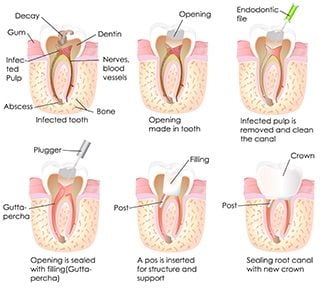
A root canal procedure is relatively straightforward. If you are anxious about the procedure, your dentist can recommend sedations options.
- First, the area around the tooth is numbed. A dental dam is often placed around the tooth to isolate the area.
- An opening in the crown is made to allow access to the pulp inside.
- Small, precise instruments are used to clean the inner pulp chamber and root canals and to remove dead or dying tissue.
- The area is thoroughly disinfected.
- The inside of the tooth is shaped to hold a filling.
- The roots and pulp chamber are filled with gutta-percha or a dental composite and sealed.
A crown is typically used to protect and reinforce the tooth after treatment. A temporary filling or crown will be placed on the tooth to prevent bacteria and food from entering the site while a permanent crown is created. This permanent crown will be placed at a later visit. The entire process usually takes from one to three appointments.
Symptoms of Pulp Infection
A tooth that needs root canal treatment might be symptom-free, but any of these symptoms are strong indications that the pulp has suffered infection or injury:
- Persistent tooth pain, which can be dull or sharp and severe
- Pain when chewing or when any pressure is placed on the tooth
- Prolonged sensitivity to heat or cold
- A cracked, broken, darkened, or discolored tooth
- Gum tissue near the tooth which is sore, red, or swollen
- A pimple-like bump on the gums that persists or keeps recurring. This is the sign of an abscess, an infection in the gum or bone near the root of the tooth.
A root canal should be performed by an endodontist or a dentist who has special training in treating the interior of the tooth. Call your dentist immediately if you have any symptoms of pulp infection or injury. Prompt endodontic treatment can relieve tooth pain and prevent further infection. And, with proper dental care and regular checkups, your restored tooth can last a lifetime.
The post Root Canal Treatment appeared first on Pender Dental Care.
]]>The post Root Canal Retreatment appeared first on Pender Dental Care.
]]>A few instances that require the need for endodontic retreatment:
- The infection in your tooth did not heal properly
- Placement of your crown or other restoration was delayed
- New decay has formed
If your endodontist thinks you need retreatment, you both will discuss treatment options and choose the one that best suits your situation. Your endodontist will begin by reopening your tooth to gain access to the root canal filling material. Removal of restoration and filling material allows access to blocked canals. After removing the canal filling, the endodontist will clean the canals and carefully examine the inside of your tooth using magnification and illumination, searching for any additional canals or unusual anatomy that requires treatment. Your endodontist will then clean the canals, seal them, and place a temporary filling in the tooth. After your endodontist completes retreatment, you will need to return to your dentist as soon as possible to have a new crown or other restoration placed on the tooth to protect and restore it to its full function.
The post Root Canal Retreatment appeared first on Pender Dental Care.
]]>The post Root Canal FAQs appeared first on Pender Dental Care.
]]>The roots of your teeth have small openings, called root canals, which allow blood vessels and nerve fibers to bring nutrients and sensation to your teeth. If infection occurs in or around these small openings, it can damage the pulp inside of the tooth.
A root canal treatment is a procedure that removes damaged pulp from inside the tooth, and protects it from future infection.
Why do I need a root canal?
If tooth pulp becomes acutely inflamed or infected, it needs to be removed in order to save the tooth.
Pulpal damage is commonly caused by:
- Physical trauma, like a sports injury, that impacts the teeth
- Tooth decay (like a cavity) that advances into the root canal. Bacteria reaches into the pulp and nerve endings, causing infection, decay, and extreme sensitivity
- Broken teeth that expose the pulp to bacteria
Symptoms include:
- Tooth pain while chewing
- Tooth sensitivity to temperature
- Swollen gums or face
- Discolored or gray teeth
Is there an alternative?
The only alternative is to have a tooth extraction, which isn’t recommended because extraction can cause problems like teeth shifting position, difficulty chewing, and loss of jawbone density.
Root canal treatment has a 98% success rate, and can heal the tooth for a lifetime.
Is a root canal treatment painful?
A root canal treatment is done under local anesthesia, and might feel very similar to getting a filling.
What will happen during the procedure?
First, the affected area is numbed, and a dental dam is placed around the tooth to keep it dry during the procedure. A small opening is made at the top of the tooth and small tools are used to take out the infected pulp. Then the tooth is disinfected and filled with an inert, biocompatible material, and sealed with adhesive cement.
What will happen afterwards?
Pain and sensitivity might last for a few days after treatment, and can be relieved with over-the-counter medication like ibuprofen. You might be instructed to avoid chewing on the affected tooth for a few days. After a few days, the temporary filling is removed and replaced with a permanent filling or crown.
How can I avoid the need for root canal treatment?
You can prevent the need for root canal treatment by brushing and flossing every day, and scheduling regular cleanings. Acidic beverages, like soda, and sugar can contribute to infections in the mouth, so it’s best to avoid them. If you’re active in sports, it’s best to wear a mouthguard to protect your teeth from injury.
The post Root Canal FAQs appeared first on Pender Dental Care.
]]>The post Combined Root and Gum Problems appeared first on Pender Dental Care.
]]>Symptoms
If you are experiencing any of these symptoms, they should never be ignored:
- Dull or intermittent discomfort
- Tooth sensitivity due to temperature
- Tooth sensitivity due to pressure
- An ache from a group of teeth or single tooth
- An ache from your sinuses
These symptoms can suggest a variety of dental issues, including root canal and gum problems. Disregard the pain and it sometimes will go away on its own. However, this usually signifies that the pulp in your tooth has died. With the nerve no longer functioning properly, there will be the absence of pain. If your condition has gotten this far, it can become far more serious.
How Infection Occurs
Once the pulp inside your tooth has become severely infected, these stages of infection occur:
- The disease moves through the end of the root and outside the tooth.
- Infection then spreads to the periodontal ligament, which is vital for anchoring the tooth to the surrounding bone and gum tissue.
- Gum tissue is infected and can cause periodontal disease or a gum abscess.
In reverse, the infection begins in the gums and goes through these stages:
- The gums have developed periodontal disease due to plaque buildup.
- Infection travels through passageways in between tooth roots.
- Infection then spreads to the pulp inside your tooth.
Prognosis of Saving Your Natural Teeth
Your dentist will want to do everything they can to save your natural tooth or teeth. But sometimes, this can be challenging due to the progression of infection. An infection that begins in the tooth root has a better chance to be treated than an infection that began in the gums. If the gums are infected severely enough with periodontal disease, it is likely that most of the bone has been eroded away. In this case, saving the tooth may not be possible.
It’s important to note that root canal and gum problems do not get better as time passes. Immediate care is essential for stopping the infection in its early stages.
The post Combined Root and Gum Problems appeared first on Pender Dental Care.
]]>The post Broken Teeth appeared first on Pender Dental Care.
]]>Tooth injuries can cause self-consciousness, sensitivity, and pain. More serious fractures can lead to infection and further damage to the tooth and its surrounding tissues. Depending on the extent of the injury to your tooth, there are several options available for restoring its appearance and function.
- Reattachment
It may be possible to reattach a broken tooth fragment if the damage is not too severe and you act promptly. Call your dentist for instructions on how to preserve the tooth fragment and make an appointment for treatment as soon as possible.
- Contouring
Contouring is used to repair minor cosmetic damage caused by small chips. The jagged or uneven edge of the enamel is gently reshaped with a drill or laser, and then the edge is polished for a smooth, even appearance.
- Bonding
A tooth with a small chip or crack could be a good candidate for bonding. A tooth-colored composite resin is applied to the damaged area with an adhesive, molded to shape, and then hardened with a curing light.
- Veneer
Veneers are popular options for restoring front teeth with chips and minor cracks. A veneer is a thin, tooth-colored shell made of porcelain or composite resin. The damaged tooth is shaped to accommodate the veneer at a first appointment, and an impression of the tooth is taken. A veneer is custom fabricated from this impression. At a second appointment, the tooth’s front surface is prepped and the veneer is bonded to the tooth.
- Onlay
An onlay restores a molar or premolar when one or more cusps have cracked or broken. Because an onlay is placed only on the center and any damaged cusps of the tooth, it preserves more of the natural tooth than a crown. The injured tooth is cleaned and shaped, and an impression is made which will be used to fabricate the onlay at a dental lab. The onlay will be bonded to the tooth at a second appointment.
- Crown
If too much of the tooth structure is damaged or missing, a crown can restore the tooth’s appearance and function. The injured tooth is shaped and prepared, an impression is made, and a crown is custom fabricated to cover and protect the remaining tooth structure. If the pulp is damaged, a root canal is usually necessary to save the tooth before the crown’s final application.
- Extraction
If the tooth has lost too much structure, if a crack extends below the gum line, or if a root is broken, extraction might be necessary. A dental implant after extraction is often the best treatment for long-term dental health. Implants can prevent shifting in the surrounding teeth, difficulties with eating and speaking, and loss of bone beneath the missing tooth.
Any injury to a tooth should be treated promptly to prevent possible infection and further damage to the tooth and the tissues around it. If you suffer any kind of dental trauma, call your dentist right away to discover the best options for restoring the health and appearance of your smile.
The post Broken Teeth appeared first on Pender Dental Care.
]]>The post Apicoectomy appeared first on Pender Dental Care.
]]>Every tooth contains pulp tissue, both inside the crown above the gum line and in the canals within the roots. These canals are small tunnels which travel from the pulp chamber in the crown to the tip of each root.
Nerves and blood vessels connect pulp tissue to the nervous and circulatory systems in the body, entering and exiting the tooth from very small openings in the root tip. An infection in the root pulp can spread to the gum and bone tissue around it through these openings.
An apicoectomy, also known as a root-end resection, is the surgical removal of the apex, or tip, of a tooth’s root. This allows your dentist to access and remove any damaged and infected tissue within and around the root. Apicoectomies are common endodontic surgeries, performed with state-of-the-art diagnostic and surgical tools.
- Often local anesthesia is all that is needed. If you are interested in sedation, discuss your options with your dentist. Once the area around the root is numb, an incision is made in the gum tissue to allow access to the root and any affected bone tissue.
- Your dentist will carefully remove a few millimeters from the tip of the root, then clean the infected part of the root and remove any inflamed or infected tissue from the bone surrounding it. The root will be filled and the tip sealed.
- Sutures will be used to close the incision, which will dissolve on their own or be removed at a follow-up visit.
- Your dentist will let you know just how to take care of the site after surgery. You should follow post-op instructions carefully to reduce any swelling, and be sure to follow any dietary suggestions and restrictions.
- Pain or sensitivity after the procedure can be treated with over-the-counter anti-inflammatory pain relief such as ibuprofen, or your dentist might prescribe prescription pain relief. Your dentist will also prescribe antibiotics as necessary to treat infection.
Most often, an apicoectomy is performed when infection occurs after a root canal procedure. (Your dentist may also recommend this procedure if you have calcium deposits in the root, if a crown or bridge makes a typical root canal impractical, or if the root of a tooth or the bone around it suffer trauma.) Common symptoms of infection include:
- Pain which can be mild or very intense
- Sensitivity to pressure or temperature
- An abscess, pus, or discolored discharge near the tooth
- Swelling, redness, or tenderness in the gums and tissues around the tooth
- A foul taste in the mouth or persistent bad breath
If you have recurring or new pain or symptoms of infection after a root canal, see your dentist promptly. Left untreated, infection can destroy tooth, gum, and bone tissue. An apicoectomy can be your best option to preserve your tooth and protect your dental health.
The post Apicoectomy appeared first on Pender Dental Care.
]]>