The post Implant Dentures appeared first on Pender Dental Care.
]]>How do implant dentures work?
Your dentist will begin by numbing the area where your implant dentures will be placed. They will then place mini implants first and securely anchor them in the surrounding bone.
Attachments are placed in the underside of the denture, which connect to the implants themselves. When the whole denture is placed in your mouth, the denture snaps onto the implants and keeps the denture stable.
Depending on how many implants are needed, the implant dental surgery can take one to three hours. Post-surgery discomfort is common but can be managed with over the counter anti-inflammatory medication, though some patients don’t even need it.
You will need to take it easy on your new implant dentures for a while after they are placed. Your dentist will advise you to eat soft foods, nothing crunchy or chewy, until your healing process is complete. It may take up to three months to heal.
Benefits of Implant Dentures
The process of getting your implant dentures is indeed worth it. Implant dentures offer many great benefits that will last you a lifetime:
- More confidence when you talk, laugh, and eat in public
- More comfort since they are secure and feel like natural teeth
- They look just like natural teeth
- Prevents jaw shrinkage and bone loss
- No need for denture adhesives
The post Implant Dentures appeared first on Pender Dental Care.
]]>The post Implant Care and Maintenance appeared first on Pender Dental Care.
]]>- Poor oral hygiene
It’s especially important to brush and floss, and schedule regular dental cleanings to maintain your implant. Poor oral hygiene can lead to a bacterial infection called peri-implantitis. Peri-implantitis threatens the quality of the soft tissue and bone supporting the implant. If you notice redness and swelling around your implant, or if your implant is loose, you should see your healthcare provider immediately.
- Excessive biting forces
If you clench or grind your teeth, you might need a nightguard to protect your teeth and implant. Nightguards are made with soft, flexible material that absorbs the impact of the clenching and grinding to protect your teeth and implant.
In some cases, you might need more implants to handle the forces generated by biting and chewing. Your healthcare provider will measure your bite force and determine the best number of implants for you, as well as the best implant diameter and length.
The post Implant Care and Maintenance appeared first on Pender Dental Care.
]]>The post Dental Implants appeared first on Pender Dental Care.
]]>How do dental implants work?
A dental implant is a metal post, usually made of titanium, which replaces the root portion of a missing tooth. Your dentist will then place a replacement tooth to the post, which can be permanently attached or removable. Permanent replacement teeth are more stable and feel more like natural teeth.
An ideal candidate for dental implants:
- Is a non-smoker
- Has maintained good oral health
- Has healthy gums with no signs of gum disease
Single or Multiple Dental Implants
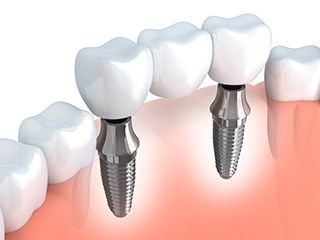
Dental implants are very versatile. If you’re missing one tooth, one implant and one replacement tooth will take care of your problem. If you’re missing several teeth in a row, a few strategically placed implants can support a permanent bridge. Similarly, if you have lost all of your teeth, a full bridge or full denture can be permanently fixed in your mouth with a strategic number of implants.
Dental Implants vs. Dentures and Bridges
Unlike dental implants, bridges and dentures are not fixed to the bone. This can result in them being unstable, making it difficult to eat or smile with the confidence you want. Dental implants look, feel, and act more natural, just like your natural teeth. They also have a stronger biting force. Implants do not rely on neighboring teeth for support, which is definitely an advantage since this means they won’t compromise the health of your surrounding healthy teeth. Implants are also likely to last a lifetime, whereas bridges are only expected to last seven to ten years and even less if a root canal is required.
Taking Care of Your Dental Implants
Your new dental implants should be treated just like natural teeth. They require brushing and flossing at least twice every day and regular checkups and cleanings with your dentist. The better you take care of your implants, the more likely they truly will last you a lifetime.
The post Dental Implants appeared first on Pender Dental Care.
]]>The post Dental Implant FAQs appeared first on Pender Dental Care.
]]>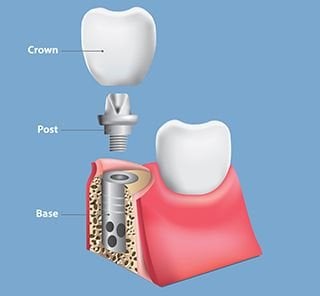
A dental implant is a small post that serves as a replacement for a tooth root. An abutment, also known as a connector, is built and placed on the top of the implant, connecting to the replacement tooth. The replacement tooth is a crown that is created to uniquely match your natural teeth.
Dental implants can be made from different materials, due to the advancement of technology and research. However, the most commonly used materials are titanium and zirconia. Titanium is able to create a permanent fixture with bone. It is one of the most sought after metals for dental implants because of its durability and long lasting replacement solution at a reasonable price. Zirconia, a type of ceramic, has emerged as an alternative to titanium. It might be the preferable material for those who have metal allergies.
Why do I need dental implants?
There are a variety of reasons why people might need dental implants. Gum disease, tooth decay, or physical trauma all have the potential to cause teeth to fall out. The only treatment options available to these patients used to be prosthetics like dentures and bridges. Today, dental implants have become a popular option for patients seeking to replace missing teeth. Dental implants replace the tooth root, creating a strong foundation for prosthetic teeth to be built upon.
What are the advantages of dental implants?
Dental implants are proven to be successful and able to last a lifetime. Advantages include improved oral health, comfort, appearance, speech, eating, and confidence. Dental implants also provide better durability and convenience. Unlike dentures where you have to remove them from time to time, dental implants eliminate this step altogether. Once they’re in your mouth, they act as a natural part of your mouth.
How many dental implants can I have?
You can have a single implant or multiple, depending on how many teeth you’re missing. You also don’t need an implant for every tooth that you are missing. One implant can replace a single tooth or support a bridge, but you need at least four to replace a full row of teeth.
Is the procedure painful?
Typically, patients find dental implant surgery quite easy to go through. Any pain after surgery can be managed with over the counter anti-inflammatory medication or icing the area.
How do I take care of my dental implants?
Just like natural teeth, you need to maintain a good oral hygiene routine. Brushing and flossing at least twice a day every day, as well as seeing your dentist for regular checkups and cleanings, will keep you on the right track.
Is the procedure expensive?
Dental implants can cost a bit more than other tooth replacement options such as dentures, but they are proven to last a much longer time. They should never require replacement if you keep a good oral hygiene routine.
What if my body rejects my new dental implant?
It is very rare that your body will reject your new dental implant, since the implant has no living cells in it. Allergic reactions to the titanium in the implant are also very rare. However, an implant can fail to adapt to your jawbone, in which case an infection would develop. You can prevent this from happening by maintaining good oral hygiene, seeing your dentist regularly, and not using a strong biting force soon after surgery.
Are there certain requirements to get dental implants?
You will first need to meet with your dentist to complete a total examination on your mouth, including X-rays of your jaw. This will ensure that there are no underlying problems and that you are indeed a candidate for dental implants. If your dentist believes that you do not have enough bone density for a dental implant, you may be able to get a dental bone graft to prepare for dental implants. A dental bone graft adds volume and density to your jaw in areas where bone loss has occurred. It’s important that you have enough bone density so that the foundation of your tooth is strong enough to withstand a dental implant.
The post Dental Implant FAQs appeared first on Pender Dental Care.
]]>The post Consequences of Losing Teeth appeared first on Pender Dental Care.
]]>Bone needs stimulation to maintain its form and density. When you lose teeth, your jawbone loses the stimulation it needs to stay strong and keep its form and begins to deteriorate.
Consequences of bone loss in the jaw include:
- A 25% decrease in jawbone width, in just the first year of tooth loss
- Change to face structure and aesthetics
- Increased change of bone fracture in face and jaw
- Movement of other teeth, creating bite misalignment
- Possible TMJ pain from change in bite
Tooth Replacement Options
- Dental implant
A dental implant is the most recommended tooth-replacement treatment because it restores the look, feel, and function of a real tooth, and because the implant fuses directly into the jawbone, it prevents bone loss. It also has over a 95% success rate—the highest of any tooth-replacement option.
Dental implants require a minor surgical procedure with local anesthesia. The implant is placed directly into the jawbone and capped with a lifelike dental crown, to give you the feel and function of your natural teeth.
- Partial or full dentures
Dentures are removable replacements for missing teeth and surrounding tissues. Partial dentures are used when only some teeth are missing, and put pressure on existing teeth and bones. This pressure can accelerate the bone loss process, and loosen any existing teeth.
- Bridgework
Bridgework refers to the use of a false tooth to create a bridge between two healthy teeth. Bridgework relies on support from two adjacent, possibly healthy, teeth that must be filed down and capped, making them vulnerable to decay and root canal problems.
While they can restore the look of a real tooth, they do not address bone issues that occur after the loss of a tooth.
Both dentures and bridgework are less expensive than implants in the short-term, but don’t prevent bone loss and may need to be replaced themselves, making implants the best investment for long-term health, function, and aesthetics.
The post Consequences of Losing Teeth appeared first on Pender Dental Care.
]]>The post Bone Grafting appeared first on Pender Dental Care.
]]>Bone loss in the jaw can have serious consequences for your dental health. Bone loss leads to loosening and eventual loss of teeth. Teeth shift, affecting your bite. Lack of bone density makes the placement of dental implants or implant-supported dentures impossible. Further, facial muscles and features lose structural support, causing a sunken appearance in the lips, cheeks, and chin.
Conditions that Cause Bone Loss
- Resorption
When a tooth is lost, the bone ridge under the missing tooth gradually begins to shrink, a process called resorption. Without the stimulation of biting and chewing, new bone cells aren’t produced quickly enough to replace older bone tissue.
- Periodontitis
Gum disease is progressive, and a leading cause of tooth loss. Left untreated, periodontitis causes gum recession, exposing bone and connective tissue to destructive bacteria and infection.
- Trauma
Bone damage caused by trauma might require bone replacement or recontouring.
- Bone Structure and Size
Sometimes the alveolar ridge is too narrow or shallow to support an implant, especially in the back of the upper jaw near the sinus cavity. In this case, the bone will need to be built up before an implant can be placed.
Bone Graft Procedure
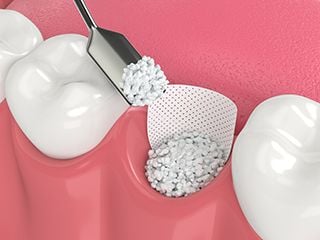 To prevent bone loss from affecting your quality of life, your dentist might recommend a bone graft. During this procedure, grafting material is implanted in the damaged area, where it serves as a platform for your own bone tissue to regenerate and restore bone volume and density.
There are several types of grafting material, and your dentist can help you choose the type of graft which will work best for you.
- Autografts: Bone tissue taken from elsewhere in your body
- Allografts: Screened and prepared bone material provided by a human tissue bank
- Xenografts: Screened and prepared bone provided by an animal tissue bank (typically cow bone)
- Alloplastic grafts: Synthetic grafting material manufactured with biocompatible mineral compounds
- Growth factors might be applied with the grafting material to stimulate cell growth
Autografts, because they use your own living tissue, can regenerate new bone cells and are resorbed over time. Other graft materials serve as a framework for your bone tissue to build upon.
A bone graft is typically performed using local anesthesia. If you are interested in sedation, your dentist can suggest options. During the procedure, an incision is made in the gum tissue to reveal damaged or missing bone. Grafting material is placed and shaped to restore the bone’s contours. A protective membrane may be placed over the graft to stabilize it and to prevent gum tissue from growing into the graft area.
The gums will be closed with sutures. The membrane and sutures may dissolve over several days or weeks, or you may need to return to have them removed. You’ll receive detailed instructions for after care and follow-up visits. The time it takes for you to heal completely will depend in part on the size and type of your graft.
Bone grafts can restore the shape, size, and density of your jawbone, protecting you from further bone and tooth loss and providing a solid foundation for implants. Talk to your dentist to discover how bone grafting can improve your dental health and transform your smile.
The post Bone Grafting appeared first on Pender Dental Care.
]]>