The post Your First Orthodontic Visit appeared first on Pender Dental Care.
]]>What happens at the initial appointment?
- Introductions: Getting braces for the first time can be daunting, so it’s important that proper introductions are made to help ease anxiety. You will meet with your orthodontic team; they will do everything they can to make sure you’re comfortable.
- Paperwork and health history: A team member will ask you to fill out paperwork regarding your relevant health history. It also informs your orthodontic team if you’ve had X-rays in the past or any previous oral issues you may have experienced.
- Exam and X-rays: During a thorough examination of your teeth, an orthodontic team member will use advanced 3D scanning, X-rays, and visual inspection. This helps them understand the unique needs of your teeth to build an effective treatment plan.
- Treatment plan: Generally, there may be a few orthodontic treatment options available to you. Together with your team, you will decide which plan works best for you. This can even be based on budget, predicted results, and treatment length.
- Patient questions: Once a treatment plan has been chosen, you will be given the floor to ask any and all questions. Your orthodontic team wants to make sure you have a solid understanding of what to expect in the next coming months, so questions are highly encouraged in order to address concerns and alleviate anxiety.
- Finances: A team member will review your insurance and discuss the payment options for your treatment. Some orthodontic offices offer flexible financing options or payment plans to help make costs more manageable.
- Your next appointment: Once your first appointment is completed, a team member will schedule your following appointment to put your treatment plan into action.
The post Your First Orthodontic Visit appeared first on Pender Dental Care.
]]>The post Your Child’s First Teeth appeared first on Pender Dental Care.
]]>Eruption of Baby Teeth
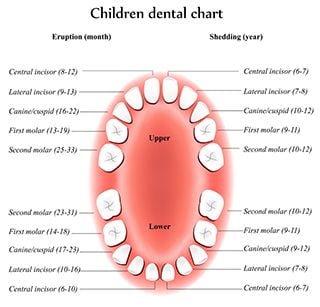
Baby teeth typically erupt in the lower front teeth region, with most children obtaining all their baby teeth by three years old. For some children, this timeline varies. Some may not experience their first erupted baby tooth until their first birthday.
Teething
Teething is an indicator that your child’s baby teeth are coming in, and is usually accompanied by slight discomfort, excessive drooling, and swollen or tender gums. Some tips to remember when teething begins include:
- Massage your child’s gums with a clean finger to ease some discomfort.
- Offer a solid, not liquid-filled, teething ring (can be frozen).
- Offer a clean, frozen, or wet washcloth.
- Offer a teething biscuit, but be sure to monitor your child while they eat it.
- If discomfort persists, talk to your child’s pediatrician about a safe dose of liquid acetaminophen.
- Avoid teething tablets that contain belladonna and benzocaine gel, as these substances can be potentially toxic to your child.
- Never use a teething necklace, as your child will be at risk for strangulation or choking.
Proper Oral Hygiene
Once your child’s first tooth comes in, you will need to begin an oral hygiene routine with them. The process slightly changes as they grow, so some helpful tips include:
- Brushing twice a day with a grain-of-rice-sized dollop of fluoride toothpaste, especially after consuming foods or beverages.
- Refrain from letting your child go to bed with a bottle since this can lead to tooth decay.
- When your child turns three years old, you may increase fluoride toothpaste to a pea-sized amount when brushing.
- When your child is at the developmental stage where they can spit, teach them to spit out the excess toothpaste after brushing.
- It’s recommended that the parent place the toothpaste on their child’s toothbrush until they reach six years of age.
- Parents should monitor and assist their child while brushing until they reach seven or eight years old.
Importance of Fluoride
Fluoride is an essential mineral for preventing tooth decay, as it works to harden the enamel of the teeth. Fluoride is often found in tap water, rarely ever bottled, so it’s a good idea to give your child tap water when they begin eating solid foods. If you feel that your child is not consuming enough fluoride, talk to your pediatric dentist about fluoride supplements.
The post Your Child’s First Teeth appeared first on Pender Dental Care.
]]>The post Types of Braces appeared first on Pender Dental Care.
]]>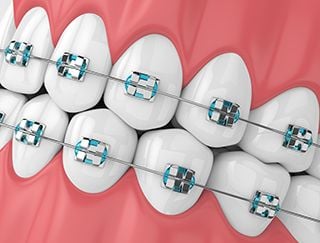
Traditional metal braces are the most common type of braces, as they correct a variety of orthodontic conditions and are generally the most affordable. Made of high-grade stainless steel, metal braces straighten your teeth using metal brackets and archwires. With metal braces, you have the option of adding colored elastics (ligatures) for a unique and colorful smile.
Self-Ligating Braces
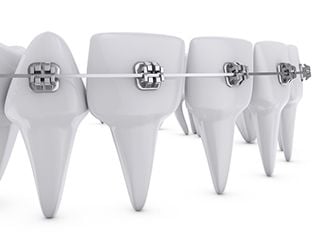
Traditional braces make use of bands around the brackets to hold the adjusting wire in place. “Self-ligating” means “self-binding” or “self-tying.” These braces use brackets, but with a very different design. Self-ligating brackets have mechanisms such as doors or clips, which hold the wire to the bracket without the need for rubber bands or metal ligatures. Without these ligatures, brackets are smaller and less noticeable. They also don’t need as many adjustments, so you’ll require fewer appointments and generally undergo a shorter treatment time.
Clear Braces
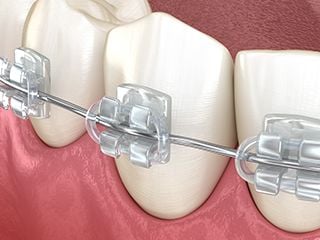
Clear braces use brackets made of clear or tooth-colored ceramic, which blend beautifully with the color of your tooth. The elastic ligatures, or rubber bands, can be chosen to match the brackets or your enamel.
Clear brackets can sometimes be somewhat larger (though this isn’t always the case), and, because they can be more abrasive than their metal counterparts, they are often recommended for upper teeth only.
Clear Aligners
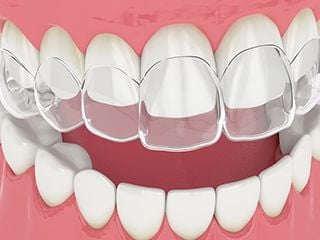
Clear aligners use a series of custom-made trays that shift teeth gradually into place. For patients who need mild-to-moderate corrections, this can be a great option.
In addition to being clear, you can change your aligners at home instead of having to visit our office every few weeks. They can even be removed while you eat, brush, and floss.
Lingual Braces
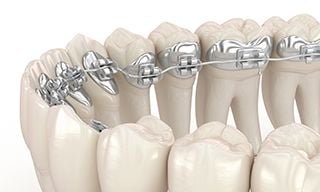
If you want corrective braces but don’t like the look of traditional braces with the metal showing on the front, you have an alternative in lingual braces. As opposed to metal braces visible across the front of the teeth, lingual braces are placed on the backsides of the teeth. Most of the metal in lingual braces is not visible to other people, unless you have widely spaced teeth.
Lingual braces are just as effective as traditional braces and are worn for the same amount of time. They are helpful for people who play contact sports or play wind instruments because lingual braces don’t get in the way. Finally, lingual braces are a great option for patients who are sensitive to plastic and can’t wear other types of clear or invisible braces.
The post Types of Braces appeared first on Pender Dental Care.
]]>The post Types of Appliances appeared first on Pender Dental Care.
]]>Elastics are small rubber bands that help move teeth into proper alignment. Typically, one side is connected to the top jaw and the other side to the bottom jaw, and are helpful in creating an ideal bite.
Forsus Nitinol Flat Spring
A Forsus is a small rod with a spring surrounding it, and is meant to replace or prevent the need of a headgear or even jaw surgery. These are typically used to address overjet or an overbite.
Headgear
A headgear is used to treat patients with either an overbite, where the front jaw extends well beyond the lower jaw, or an underbite, where the lower jaw rests in front of the top jaw. Headgear gently “pulls” on the orthodontic appliance in your mouth to encourage ideal jaw placement.
Herbst® Appliance
This appliance attaches to the back teeth and applies constant forward pressure on the lower jaw, and constant backwards pressure on the upper jaw in order to correct an overbite.
Palatal Expander
This device is used to widen the upper jaw. Adjustments are made periodically to maintain pressure on the jaw so that it keeps growing. Once you’ve achieved desired expansion, you will wear the appliance for several months to solidify progress made.
Positioners
Similar in feel to clear plastic retainers, positioners are used to complete final tooth movement and placement without the need for braces.
Retainers
Made from plastic, metal, or a combination of both, retainers are necessary to help keep your teeth in place once your braces come off.
Separators or Spacers
Separators or spacers are tiny rubber bands that are placed between your back teeth. The bands push the teeth apart, making space for metal bands, which hold other appliances in place, like braces or palatal expanders.
Twin Block Appliance
The twin block appliance is made of two acrylic blocks that work together to advance the lower jaw position and correct an overbite. This appliance is made to be worn full time, including while eating, though it is removable for easy hygiene.
Mara Appliance
MARA stands for Mandibular Anterior Repositioning Appliance. It is not removable and anchored to the molars, requiring periodic adjustment by your orthodontist. It works to encourage lower jaw growth to correct severe overbites.
The post Types of Appliances appeared first on Pender Dental Care.
]]>The post Thumb and Finger Appliances appeared first on Pender Dental Care.
]]>There are a variety of appliances available, each one different from the other, and they all do the same thing: they prevent your child from placing their thumb into their mouth. Over time and with consistent wear, your child’s thumb sucking days will be over.
Types of Thumb Sucking Appliances
There are five types of thumb sucking appliances available to your child. Choosing one just depends on the severity of the habit and what will work best for your child. These types include:
- A removable appliance can be removed and replaced in the mouth at any time. This appliance will only work if your child constantly wears it as instructed. A child who does not want to stop their thumb sucking habit will more than likely remove the appliance often. Because of this, the success rate of removable thumb sucking appliances is quite low. However, a great advantage to this type of appliance is that it can be removed before eating and thorough cleaning of the teeth and gums can continue without it inserted.
- A fixed appliance cannot be removed from the mouth at will. Thumb suckers will have no choice but to break their habit. However, since they cannot be removed, eating, speaking, and thoroughly cleaning your child’s teeth and gums will be a little more challenging.
- A thumb crib uses a sort of cage or fence that rests just below the roof of your child’s mouth. Thumb crib appliances work by preventing the pressure and sucking sensation at the roof of the mouth. Without the comforting stimulus that comes with thumb sucking, the habit is deemed useless by the wearer over time.
- A bluegrass appliance involves a roller, which is placed at the front half of the roof of the mouth. Instead of sucking their thumb, your child is given the alternative of turning the roller over with their tongue. This device is based around positive reinforcement and is less aggressive. It can be placed in children as young as six or seven years old.
How long should my child use this device?
The appliance can be used to break a thumb sucking habit until it stops altogether, but it also needs additional use after the habit breaks. This is to ensure that the habit does not promptly return. Typically, for children with mild to moderate thumb-sucking habits, it is worn for around three to six months. A persistent thumb sucker may need to use the appliance for a year.
Benefits of Thumb Sucking Appliances
More than just breaking the habit of your child sucking their thumb, there are other great benefits to using this appliance.
- Allows proper development of the upper jaw and front teeth: Thumb sucking constricts the upper arch, flares the upper teeth, and tips the lower teeth back.
- Increased confidence and self-esteem: Thumb suckers are often embarrassed of the act of thumb sucking and of the physical changes it does to their teeth and bite.
- Easier to speak and eat: The changes in the position of a thumb sucker’s teeth make it challenging to speak and bite into food. Your child may be self-conscious about smiling, speaking, and eating in public.
The post Thumb and Finger Appliances appeared first on Pender Dental Care.
]]>The post Temporary Anchorage Devices appeared first on Pender Dental Care.
]]>A Simple Procedure
Your orthodontist will begin the procedure by using a local anesthetic to numb a small portion of your gum, specifically where the TAD will be anchored. When your TAD is inserted, you should only feel slight pressure. Some discomfort may occur after the procedure is finished and the anesthetic wears off. Over-the-counter pain medication will be enough to alleviate your residual pain.
It’s as simple to remove a TAD as it is to insert one. It is a quick and painless process that requires no anesthesia. After a few days have passed since its removal, the site generally heals with no lingering pain.
Taking Care of Your TAD
While the chance of your TAD getting infected is small, it’s important to prevent this from happening. The following are some helpful tips to take care of your TAD:
- After the TAD is inserted, it’s recommended to rinse your mouth twice a day for five days with an antimicrobial mouthwash. After five days, you can just dip your toothbrush into the mouthwash and gently clean around the TAD every day.
- Do not use an electric toothbrush while there are TADs placed in your mouth.
- Refrain from touching or fidgeting with your TAD.
- Your orthodontist may recommend that you switch from your normal toothpaste to one that kills oral bacteria.
The post Temporary Anchorage Devices appeared first on Pender Dental Care.
]]>The post Teen Orthodontic Care appeared first on Pender Dental Care.
]]>Types of Orthodontic Appliances
It’s important to know that oral problems requiring orthodontic treatment do not improve over time; they actually get more difficult to treat. Below are several orthodontic treatment options from which you can choose:
- Clear aligners: Perfect for patients who desire a more discreet way of correcting their teeth, clear aligners use transparent plastic trays to fix mild to moderate orthodontic problems. Even though they are removable, you will need to wear them often, no less than 20 to 22 hours a day. Teens will need to decide if they will be diligent in wearing them enough so that they are effective.
- Ceramic braces: These braces are attached to each tooth and connected with an archwire. Teens won’t have to worry about how much time they’ve worn them because they straighten their teeth all day, every day. Their treatment plan will also move forward smoothly. Ceramic braces are a common alternative to clear aligners as they use tooth-colored material.
- Lingual braces: Similar to braces that also use brackets and wires, these braces are placed on the back of the teeth facing your tongue, rather than the front of your teeth. Lingual braces are used for correcting teeth misalignment, and they are also almost completely invisible.
- Self-ligating braces: These braces look like traditional braces; however, they lack the ligature, which is the elastic that is wrapped around traditional braces. Clips and brackets encourage your teeth to move in their correct places. Self-ligating braces have also been known to produce less pain and discomfort.
- Metal braces: An orthodontist’s go-to for treatment, metal braces are great for teeth that move significantly. Clear aligners cannot do the same. With the advancements of technology, traditional braces are lighter and more versatile.
- Growth modification appliances: Most commonly used on younger patients, growth modification appliances help correct an overbite without tooth extractions. Since this appliance modifies the growth of bone, it is the perfect choice for teens and children who are still physically developing, as their bone tissue is more pliable. This treatment is also used for patients who have an underlying jaw discrepancy due to genetics, trauma, or bad habits.
The post Teen Orthodontic Care appeared first on Pender Dental Care.
]]>The post Orthodontic Retention appeared first on Pender Dental Care.
]]>During the retention period, you will be given a retainer to wear for at least 22 hours a day, for at least 24 months. After the retention period, you can wear your retainer less, going from nightly to only a few nights a week.
If you don’t wear your retainer, your teeth might revert to their former position, and you will lose the progress made. Teeth aren’t set in the jawbone, instead, they are held in place by a network of fibers called periodontal ligaments. After teeth have been moved, it takes several months for the periodontal ligament to support and adjust to new positions of the teeth. When you wear your retainer, you are supporting the periodontal ligaments and making sure that your teeth stay exactly where you want them.
In most cases, you will be fitted for a retainer right after your braces come off, and it will be made and prepared for you in office. There are three types of retainers:
- Hawley retainer
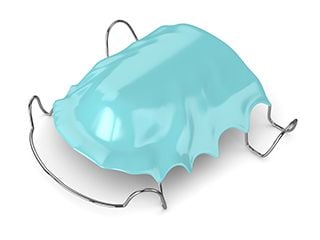
The most popular and durable type of retainer, the Hawley retainer is designed with a thin, tongue-shaped mold that holds a wire across your teeth to keep them in place.
- Clear plastic retainer
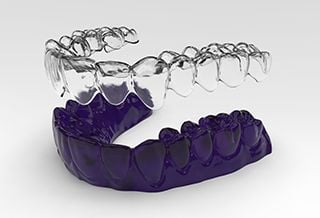
These look and feel like clear aligners. They are made from plastic to fit exactly over your teeth and secure them.
- Fixed bonded retainer
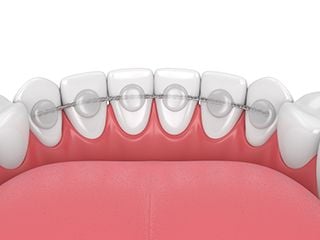
A fixed bonded retainer is typically used on the front bottom teeth. A small wire is cemented to the tongue side of the teeth to keep them in place.
It’s important to clean your retainers. For Hawley retainers, you can brush them with a regular toothbrush. For clear plastic retainers, denture cleaner might be the best option. Fixed retainers have similar cleaning methods to braces, and you’ll likely need special tools to floss underneath the wire.
It’s also very important to carry your retainer case with you. So often, retainers are lost in a napkin and accidentally discarded. Retainers must also be kept away from very ho
The post Orthodontic Retention appeared first on Pender Dental Care.
]]>The post Orthodontic Headgear appeared first on Pender Dental Care.
]]>Types of Orthodontic Headgear
Whereas braces are permanently fixed on the teeth, headgear can be removed and is worn partially outside the mouth. Depending on the patient’s needs, there are three types of orthodontic headgear your orthodontist can choose from:
- Cervical Pull: This type of headgear is used to correct a malocclusion called an overjet, which appears as a protruding top jaw and front teeth. This device can also correct overbites, which is when the top and bottom teeth don’t meet properly. Cervical pull headgear uses straps that wrap around the neck and attach to the braces in the mouth.
- High Pull: This type of headgear corrects an overjet or overbite. Straps are attached from the upper jaw to the top and back of the head. This device is also used in children with excessive jaw growth in the back of their mouth.
- Reverse Pull: This type of headgear is used for underdeveloped upper jaws or underbites. When the lower teeth jut out past the upper teeth, it results in an underbite. This device uses rubber bands to attach to braces on the top teeth.
Using Orthodontic Headgear
It is vital to follow the orthodontist’s instructions when using headgear. Successful treatment can only be achieved if the device is worn anywhere from 12 to 14 hours a day, sometimes longer. A strict routine is important, for even small lapses will inhibit the rate of treatment. In total, headgear may be required anywhere from one to two years.
Orthodontists understand that wearing such a device in public may be embarrassing. That is why they recommend wearing the headgear promptly after school, through the rest of the evening, and overnight.
Discomfort is normal, especially when using headgear for the first time. At each visit, the orthodontist will adjust the headgear, and it could feel like there is more pressure being applied on the jaw. This sensation is very temporary. If discomfort does not lessen, over-the-counter pain medication may be taken to relieve pain. Additionally, cold foods such as popsicles may provide some relief.
The post Orthodontic Headgear appeared first on Pender Dental Care.
]]>The post Orthodontic FAQs appeared first on Pender Dental Care.
]]>Orthodontists are dental specialists who diagnose and treat problems with the position, alignment, and spacing of the teeth, and related irregularities in the face and jaw. They provide and maintain oral appliances like braces.
When would I need an orthodontist?
Orthodontists treat bite problems and teeth misalignment. Treatment will not only improve functioning of the mouth, but also leave you with a great smile.
How do I know if I need orthodontic treatment?
There are two main reasons to seek orthodontic treatment: bite problems and teeth misalignment. Teeth that are protruding, erupting out of position, or overcrowded are common indications that treatment is needed. Less obvious signs include mouth breathing, frequent biting of the cheek or palate, speech difficulties, and thumb sucking that goes past the age of three to four years of age. Other signs of orthodontic problems include jaw clicking, and your teeth not meeting when you close your mouth.
When should I start treatment?
It’s never too late to start orthodontic treatment, but starting early can make treatment faster and easier. The American Association of Orthodontists recommends that a child who may need orthodontic treatment should come in for a first visit around age seven.
Do braces hurt?
Some people experience minor aches and pain in the first few days after they get braces. Braces are periodically adjusted, which can cause soreness and typically lasts a few days. Over-the-counter pain relievers can help, but are usually unnecessary.
How long does treatment take?
Treatment differs for each person, but most commonly lasts between six months to two years. After the braces come off, a retainer must be worn for an additional several months.
How often do I need to come in for an appointment?
Appointment frequency varies from person to person, but typically ranges from every four to ten weeks.
Will I need to have any teeth extracted?
In cases of severe crowding (where the mouth isn’t big enough to hold all the teeth) or in the case of an impacted tooth (where a tooth is trapped beneath the gum line by other teeth), an extraction may be necessary. In the case of younger patients, early treatment may make extraction unnecessary.
Will I have to watch what I eat?
Yes. You might need to avoid some foods because they can damage braces; you will be given a list when you start treatment. For example, sticky foods like caramel and taffy should be avoided, as they might cling to the metal and wires in your mouth.
Will I be able to play sports/play my instrument?
Yes, but there are some things to consider. Because you might experience pain right after getting braces or getting your braces adjusted, it might take a couple days before you can play your instrument. As always, we recommend wearing a mouthguard while playing most sports.
Do I still need to see my regular dentist while I’m getting orthodontic treatment?
Definitely. With braces, it’s more important than ever to take care of your oral health, as it’s easier for food to collect between teeth and plaque to develop.
Will I need to wear a retainer after my braces come off?
Wearing your retainer is an important part of orthodontic care and helps to make your new smile permanent. If this step is skipped, teeth can shift out of place.
Is orthodontic treatment expensive?
Orthodontic care is a long-term investment in your health and well-being. There are financing options that can make orthodontic care affordable.
The post Orthodontic FAQs appeared first on Pender Dental Care.
]]>