The post Your Child’s First Teeth appeared first on Pender Dental Care.
]]>Eruption of Baby Teeth
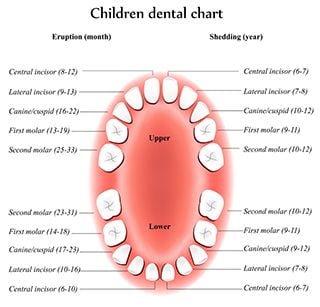
Baby teeth typically erupt in the lower front teeth region, with most children obtaining all their baby teeth by three years old. For some children, this timeline varies. Some may not experience their first erupted baby tooth until their first birthday.
Teething
Teething is an indicator that your child’s baby teeth are coming in, and is usually accompanied by slight discomfort, excessive drooling, and swollen or tender gums. Some tips to remember when teething begins include:
- Massage your child’s gums with a clean finger to ease some discomfort.
- Offer a solid, not liquid-filled, teething ring (can be frozen).
- Offer a clean, frozen, or wet washcloth.
- Offer a teething biscuit, but be sure to monitor your child while they eat it.
- If discomfort persists, talk to your child’s pediatrician about a safe dose of liquid acetaminophen.
- Avoid teething tablets that contain belladonna and benzocaine gel, as these substances can be potentially toxic to your child.
- Never use a teething necklace, as your child will be at risk for strangulation or choking.
Proper Oral Hygiene
Once your child’s first tooth comes in, you will need to begin an oral hygiene routine with them. The process slightly changes as they grow, so some helpful tips include:
- Brushing twice a day with a grain-of-rice-sized dollop of fluoride toothpaste, especially after consuming foods or beverages.
- Refrain from letting your child go to bed with a bottle since this can lead to tooth decay.
- When your child turns three years old, you may increase fluoride toothpaste to a pea-sized amount when brushing.
- When your child is at the developmental stage where they can spit, teach them to spit out the excess toothpaste after brushing.
- It’s recommended that the parent place the toothpaste on their child’s toothbrush until they reach six years of age.
- Parents should monitor and assist their child while brushing until they reach seven or eight years old.
Importance of Fluoride
Fluoride is an essential mineral for preventing tooth decay, as it works to harden the enamel of the teeth. Fluoride is often found in tap water, rarely ever bottled, so it’s a good idea to give your child tap water when they begin eating solid foods. If you feel that your child is not consuming enough fluoride, talk to your pediatric dentist about fluoride supplements.
The post Your Child’s First Teeth appeared first on Pender Dental Care.
]]>The post Your Child’s First Dental Appointment appeared first on Pender Dental Care.
]]>Introductions
It’s important to try to establish a non-threatening relationship between your child and their dentist. To help this along, your dentist may ask you to sit in the dental chair with your child during the examination. Or, your dentist may ask you to wait in the reception area during part of the appointment, so that a positive connection between your child and the dentist can be built. The method to ease your child’s anxiety depends on the child’s personality. Some children don’t fear the dentist at all.
Examination
During your child’s examination, the pediatric dentist will evaluate the health and development of the baby teeth, including checking for tooth decay, bite, or any oral issues with the gums, jaw, or surrounding tissues. If needed, the dentist will clean the teeth and determine your child’s need for fluoride. Asking questions will be encouraged and the dentist will educate the parent about proper oral hygiene and dental development issues to look for.
Proper Oral Hygiene
Providing education about maintaining your child’s oral hygiene is a big part of the first appointment. The routine slightly changes as your child develops, so some helpful tips your dentist may provide you with include:
- Watching out for signs that your child is teething; this is the indicator that their baby teeth have begun to erupt.
- Maintaining proper nutrition for healthy teeth.
- Brushing twice a day with a grain-of-rice-sized dollop of fluoride toothpaste, especially after consuming foods or beverages.
- Teaching your child to spit out excess toothpaste after brushing.
- Refraining from letting your child go to bed with a bottle since this can lead to cavities.
- Increasing fluoride toothpaste to a pea-sized amount after the age of three.
- Watching if your child develops any bad oral habits, such as thumb sucking, tongue thrusting, or lip smacking.
- Placing the toothpaste on your child’s toothbrush until they reach six years of age.
- Monitoring and assisting your child while brushing until they reach seven or eight years old.
- Scheduling dental checkups once every six months to help build your child’s comfort with their dentist, monitor tooth development, and to treat any oral problems that arise.
The post Your Child’s First Dental Appointment appeared first on Pender Dental Care.
]]>The post Thumb Sucking appeared first on Pender Dental Care.
]]>Thumb sucking puts excess pressure on the teeth, gums, and jaw and can alter the growth and development of the jaw, leading to an open bite. In an open bite, the front teeth do not touch as they should, and instead point outward. Because the teeth are at an angle, the front teeth are more at risk to trauma. Open bites also make eating and chewing difficult, and requires orthodontic treatment.
Here are a few things you can do to help your child to help your child stop thumb sucking:
- Praise and Reward
Positive reinforcement is the most effective way to encourage good habits. When your child avoids thumb sucking, offer praise or even a reward, like stickers. If you do notice them thumb-sucking, offer gentle reminders to stop.
- Comfort and Distract
Thumb sucking is a self-soothing tool, so if you notice your child thumb sucking during certain situations that might be stressful or boring. If this is the case, finding ways to comfort your child or even entertain them might dissuade them from the habit.
- Get Help
There are special tools that will help your child stop thumb sucking, including a bitter nail polish or an oral appliance called a tongue crib. This appliance physically prevents thumb sucking, and can usually break the habit in a few months. In other cases, sometimes having a dentist gently explain why it’s important to stop thumb sucking is all that’s needed to help your child stop.
The post Thumb Sucking appeared first on Pender Dental Care.
]]>The post Space Maintainers appeared first on Pender Dental Care.
]]>There are both fixed and removable space maintainers. A fixed space maintainer is cemented onto the adjacent teeth, and saves room for teeth that haven’t grown in yet.
There are four types of fixed space maintainers:
- Crown and Loop: A stainless steel loop is attached to an existing crown, pressing against the tooth on the other side of the gap to ensure that the space will stay open for the incoming tooth.
- Unilateral: A unilateral device uses a wire that is wrapped around the teeth and connected to a metal loop to maintain a space between two teeth.
- Distal Shoe: A distal shoe is used for molars, and is placed directly into the gum line. It guides the incoming tooth as it grows in. These maintainers might require more maintenance and check-ups to make sure it is working properly.
- Lingual: Lingual maintainers are typically used when a child is missing multiple teeth due, and are cemented to molars. Wires are connected to crowns to make space across several gaps. It’s also commonly used in congenital defects, like in cases where the adult teeth never develop. The space maintainer is then used to make room for a future bridge or dental implant.
Removable maintainers are used when the tooth is growing in or almost ready to grow in. They are sometimes made to look like an artificial tooth, and are placed between teeth to save room.
Both permanent and removable space maintainers are custom-made to fit into your child’s mouth. Space maintainers are worn until X-rays reveal that the tooth underneath is ready to erupt naturally. It is very important that anyone wearing a space maintainer keep up good oral hygiene at home and have regular professional dental cleanings.
The post Space Maintainers appeared first on Pender Dental Care.
]]>The post Sleep Apnea in Children appeared first on Pender Dental Care.
]]>The most common cause of sleep apnea in children is enlarged adenoids or tonsils. These soft tissue glands near the back of the throat partially block the windpipe during sleep.
Signs that your child might have a sleep-related breathing disorder:
- Snoring
- Pauses in breathing
- Chronic mouth breathing
- Constant tossing and turning
- Night panics
- Bed-wetting
Behaviors associated with childhood sleep apnea:
- Hyperactivity
- Difficulty paying attention
- Learning problems
- Perform poorly in school
Treatment Options for Sleep Apnea
- Surgery to remove adenoids or tonsils: If the issue is enlarged adenoids or tonsils, they can be removed.
- CPAP machine: A Continuous Positive Airway Pressure (CPAP) machine delivers mild air pressure through a mask worn during sleep to keep the airway open.
- Palatal expander: A palatal expander is a device that widens the palate of the mouth, which increases airflow.
- Oral appliances: Dental devices that are similar to an orthodontic retainer or mouthguard, an oral appliance might be recommended for older children with sleep apnea by keeping the airways open.
Identifying and treating sleep apnea in children can drastically improve their sleep and well-being.
The post Sleep Apnea in Children appeared first on Pender Dental Care.
]]>The post Sealants appeared first on Pender Dental Care.
]]>Sealants are invisible plastic resin coatings that are painted on the chewing surfaces of back teeth. Sealants smooth out teeth, making them easier to brush, as well as create a protective barrier, so food and bacteria cannot penetrate the tooth.
Because tooth enamel does not contain any nerves, placing a sealant is painless and does not routinely require anesthetic. First, the tooth or teeth to be sealed are examined, and if any minimal decay is found, it will be gently removed. After the tooth is cleaned and dried, an acidic gel will be placed on the tooth or teeth to prepare the tooth for the sealant. After a few seconds, the gel will be rinsed off, and the sealant will be applied onto the grooves of the tooth. A special blue light is used to harden the sealant.
Sealants can last up to ten years and require minimal care. Brushing and flossing regularly will keep them clean. Sealants can occasionally become loose, but they can easily be reapplied during a dental appointment.
Sealants can reduce tooth decay by up to 70%, and are a great way to prevent the need for expensive restorative treatment later in life.
The post Sealants appeared first on Pender Dental Care.
]]>The post Pregnancy and Your Child’s Developing Teeth appeared first on Pender Dental Care.
]]>There are certain steps you can take to ensure your baby is born with healthy teeth. Diet is key, and there are certain nutrients that are especially important for prenatal tooth development:
- Calcium
Calcium is the main component of teeth. If there is not enough calcium in your diet to support fetal development, your body will actually take this mineral from your bones and use it to meet your developing baby’s needs. Good for your baby, not so good for you. The best sources of dietary calcium are dairy foods such as milk, cheese, and yogurt. It can also be found in broccoli and kale.
- Phosphorous
Phosphorus helps balance the amount of calcium in our bodies, and accounts for the hardness of teeth. The richest sources of phosphorus come from dairy, red meat, poultry, seafood, legumes, and nuts.
- Vitamin D
Vitamin D helps our bodies absorb and use calcium. It is found in fish like salmon and tuna. Sometimes it is added to beverages, like orange juice and milk. It is also produced in the body naturally when skin is directly exposed to sunlight. Concerns about the negative effects of sun exposure may prevent you from getting all the vitamin D your body requires this way, so you may be advised to take a supplement.
- Protein
Protein is responsible for building, maintaining, and replacing the body’s tissues. It is the action of a single protein that causes calcium-phosphate crystals to form tooth enamel rather than bone. Meats and dairy products are the most protein-rich. It is possible to get all the different proteins your body requires with a vegetarian diet, but you will need to pay closer attention to what combinations of foods will provide all the essential amino acids.
It’s also important to know that certain antibiotics and supplements should be avoided during pregnancy. Tetracycline, for example, can permanently stain teeth in utero. Fluoride supplementation at this time is not recommended either, as there are too many unanswered questions about its use during pregnancy. Before getting a new prescription, make sure to discuss your pregnancy with your healthcare provider.
The post Pregnancy and Your Child’s Developing Teeth appeared first on Pender Dental Care.
]]>The post Nitrous Oxide for Children appeared first on Pender Dental Care.
]]>Conscious sedation involves medication to help ease tension and block pain during dental treatment, and does not put you to sleep. For pediatric treatments that opt for conscious sedation, nitrous oxide is used. Nitrous oxide is an anxiolytic, which means it makes anxiety disappear. It might cause a floating sensation, and maybe tingling in hands and feet. While under treatment, your child will be fully alert, aware of what is going on, and able to speak.
Nitrous oxide is delivered through a small mask that fits over the child’s nose. Once it has been confirmed that your child is calm and comfortable, the dental procedure can begin.
Nitrous Oxide is not a direct substitute for a local anesthetic, but sometimes an anesthetic injection is not needed while under nitrous oxide.
When treatment is over, the flow of nitrous oxide is decreased to zero, and the oxygen will be increased. After resting in the chair for a few minutes, the child will feel completely normal.
If your child’s anxiety prevents them from getting the care they need, conscious sedation with nitrous oxide might be a good option. Before your child is treated, you will be asked for a complete medical history, including any medications your child is taking. Your child will be kept safe and comfortable throughout the procedure.
The post Nitrous Oxide for Children appeared first on Pender Dental Care.
]]>The post Fluoride and Your Child appeared first on Pender Dental Care.
]]>Benefits of fluoride:
- Strengthens tooth enamel, by capturing minerals in saliva and forcing them into the tooth’s makeup
- Inhibits bacterial metabolism, slowing down the growth of bacteria and their reducing their acidic byproduct, which can weaken tooth enamel
- Inhibits tooth demineralization, meaning it can slow or stop the progression of an already existing cavity
Fluoride can be found in most drinking water, as well as most common toothpastes. Because children can overconsume fluoride, it’s important to follow these rules when it comes to fluoride and your child:
- Use only a pea-sized amount for children ages two to six, and just a tiny smear for children under two years of age
- Fluoride should not be used on children younger than six months
Overexposure to fluoride can cause a condition called fluorosis, which is characterized by a streaked or mottled appearance of the teeth. Fluorosis can look like:
- A streaked or mottled appearance on the teeth
- White spots that are hard to see
- Dark discoloration with a pitted texture
The risk for fluorosis ends by the time a child is nine years old, and all permanent teeth have fully formed.
The post Fluoride and Your Child appeared first on Pender Dental Care.
]]>The post About Pediatric Dentistry appeared first on Pender Dental Care.
]]>Pediatric dentistry is the study, practice, teaching, and research of oral care treatments and preventions in children. It is recommended that children visit their pediatric dentist twice a year. Parents should schedule the first visit within six months of their child’s first baby tooth coming in, or by 12 months of age. Regular checkups thereafter will help prevent oral health complications as your little one grows up.
Pediatric Dental Procedures
Brushing and flossing every day is the best way to prevent cavities and gum disease. However, if your child has aggressive signs of an oral disease, home hygiene will not do the job on its own and restorative treatments will be necessary. Such pediatric dental treatments include:
- Tooth fillings: Cavities and irreversible tooth enamel erosion will need to be treated with fillings. These complications usually occur from a poor diet of excessive acidic liquids and foods, as well as inadequate home hygiene. Baby teeth are more likely to be affected than permanent teeth because the enamel is thinner and less mineralized. The filling will help prevent the cavity from progressing.Pediatric pulp therapy: A baby root canal is similar to its root canal counterpart in the way that the pulp inside a tooth will be treated in an effort to save or restore it.Crowns: Made of stainless steel, crowns are placed on a child’s baby molars in an effort to protect them. This could be because the teeth have not formed properly or are already very decayed.Tooth extractions: Removing a tooth might be necessary if your child is experiencing trauma, disease, overcrowding, or decay.Space maintainers: After a tooth is extracted, a space maintainer is placed at the extraction site to ensure that your child’s tooth erupts properly. Preventive Pediatric Dental Treatments
To ensure that your child has all possible defenses to fight tooth decay, plaque, and tooth loss, there are two preventive dental treatments available. These treatments include:
- Sealants: A thin coating is placed on the deep pits and grooves of baby and permanent teeth to help prevent tooth decay.Fluoride treatment: A mineral that has been proven to decrease the progression of cavities. Since its introduction to the water supply in 1945, dental cavities in children and adults have significantly decreased. Your child can get fluoride in two other ways:
- Dietary fluoride supplements: Offered in tablet or liquid form, this supplement is only recommended for those who drink water low in fluoride or have a higher risk of developing cavities.Topical fluoride therapy: This treatment is best used for children between three and six years old. It comes in a variety of forms, such as over-the-counter fluoridated toothpaste, gels, pastes, or varnishes. The applied treatments are done only in a professional dental office.
The post About Pediatric Dentistry appeared first on Pender Dental Care.
]]>